About python class

Python For Class

Python Class

In this Python Class instructional exercise, we will investigate about Python Classes. how they work and access. Then again, we will examine what is the Python Object and various ascribes have a place with Python Class. Atlast, we spread How would we be able to erase an article, traits, or a class in Python.

Like we’ve regularly stated, Python is an item arranged language. This implies it centers around objects rather than methodology. An article can demonstrate this present reality.

In this way, we should begin Python Class and Object Tutorial.

Introduction

A class is an outline for objects-one class for any number of objects of that type. You can likewise consider it a theoretical information type. Strangely, it contains no qualities itself, however it resembles a model for objects.

How about we see the Python classes clarified in detail.

Python Class Syntax

a. Characterizing a Python Class

To characterize a class in python programming, we utilize the ‘class’ watchword. This resembles we use ‘def’ to characterize a capacity in python. Furthermore, similar to a capacity, a Python3 class may have a docstring too.

We can do this to compose a few lines clarifying what the class does. To concentrate on the language structure here, we will go in a ‘pass’ explanation in its body for the time being.

>>>> class animal:
     """
     This Python3 class creates instances of animals
     """
Pass

When we characterize a class, a Python class object is made. In any case, recollect, you can just name a class as indicated by the identifier naming guidelines as we talked about in our instructional exercise on Python Variables.

>>> fruit
<class ‘__main__.fruit’> #The class object

A Python3 class may have credits and techniques to execute on that information. We define these the standard way. We should take a example.

>>>> class animal:
          """
          This class creates instances of animal
          """
          color=''
          def sayhi(self):
                   print("Hi")
 
>>> orange=animal()

Here, shading is a trait, and sayhi() is a technique to approach an object of class organic product.

You can define a regular first-class function inside a method, yet not outside it in a Python class.

>>> class try1:
        def mymethod(self):
                 def sayhello():
                          print("Hello")
                 print("Hi")
                 sayhello()
 
>>> obj1=try1()
>>> obj1.mymethod()

Hi
Hello

You can likewise make a attribute on the fly.

>>> orange.shape='Round'
>>> orange.shape
‘Round’

b. Getting to Python Class Members

To get to the individuals from a Python class, we utilize the spot administrator. How about we make an orange article for our organic product class.

>>>> lion=animal()

Presently, how about we get to the shading property for orange.

>>> lion.sound

Presently, how about we get to the shading property for orange.

>>> animal.sayhi()

Hi

Here, we called the strategy sayhi() on orange. A strategy may take contentions, whenever characterized that way.

>>> class fruit:
         def size(self,x):
                 print(f"I am size {x}")
 
>>> orange=fruit()
>>> orange.size(8)

I am size 8

A Python class may likewise have some unique qualities, as doc for the docstring.

>>> fruit.__doc__

‘\n\tThis class creates instances of fruits\n\t’

To get more knowledge into techniques in Python, set out to find out about Python Methods. However, for the present, we’ll take a model including the init() enchantment technique and the self parameter.

>>> class fruit:
        def __init__(self,color,size):
                 self.color=color
                 self.size=size
        def salutation(self):
                 print(f"I am {self.color} and a size {self.size}")
 
>>> orange=fruit('Orange',8)
>>> orange.salutation()

I am Orange and a size 8

As should be obvious, the init() strategy is identical to a constructor in C++ or Java. It gets called each time we make an object of the class. Moreover, the self parameter is to advise the translator to manage the present item. This resembles the ‘this’ catchphrase in Java. Be that as it may, you don’t need to call it ‘self’; you can call it anything. The article is passed as the primary contention, fitting in for ‘self’. Here, orange.salutation() means fruit.salutation(orange).

Likewise, welcome is a capacity object for the Python class, however a strategy object for the occurrence object ‘orange’.

>>> fruit.salutation
<function fruit.salutation at 0x0628FE40>

>>> orange.salutation
<bound method fruit.salutation of <__main__.fruit object at 0x062835F0>>

You can store a technique object into a variable for sometime in the future.

>>> sayhi=orange.salutation
>>> sayhi()
I am Orange and a size 7

What is the Python Object?

Presently, how valuable is a Python3 class without an article? On the off chance that a class is a thought, an article is its execution.

At the point when we make an item, its init() technique is called. Also, similar to we recently talked about, the article gets went to the class through the capacity with ‘oneself’ catchphrase.

>>> orange=fruit('Orange',7)

Here, we passed ‘Orange’ and 7 as qualities for the traits shading and size. We can likewise proclaim qualities for an article on the fly. Perceive how.

>>> orange.shape='Round'
>>> orange.shape
‘Round’

You can appoint the value of an item in python to another.

>>> apple=orange
>>> apple.color
‘Orange’

Attributes Of Python Class

For clarifying this, we’ll rethink the Python class fruits .

>>> class fruit:
        size='Small'
        def __init__(self,color,shape):
               self.color=color
               self.shape=shape
        def salutation(self):
               print(f"I am {self.color} and a shape {self.shape}")

Here, the characteristic ‘size’ has a place with the class, yet we can call it on an item too.

>>> fruit.size
'small'

>>> orange=fruit('Orange','Round')
>>> orange.size
'small'

Since we reclassified the class, we announced the article again also.

In like manner, a Python class can contain a function also.

>>> class fruit:
          size='Small'
          def __init__(self,color,shape):
                     self.color=color
                     self.shape=shape
          def salutation():
                     print(f"I am happy")
 
>>> fruit.salutation()
I am happy

>>> fruit.salutation
<function fruit.salutation at 0x030C8390>

Delete Python Class, Attribute, and Object

You can erase a property, an item, or a class utilizing the del watchword.

>>> del orange.shape
>>> orange.shape
Traceback (most recent call last):
File “<pyshell#118>”, line 1, in <module> orange.shape
AttributeError: ‘fruit’ object has no attribute ‘shape’

Let’s try deleting an object

>>> del orange
>>> orange
Traceback (most recent call last):
File “<pyshell#120>”, line 1, in <module>
 
orange
NameError: name ‘orange’ is not defined

Finally, let’s try deleting the Python class itself.

>>> fruit
<class '__main__.fruit'>
>>> del fruit
>>> fruit
Traceback (most recent call last):
File “<pyshell#133>”, line 1, in <module>
fruit
NameError: name ‘fruit’ is not defined

So, this was all about Python Class and Object Tutorial. Hope you like our explanation.

Confused MUCH?  Don’t worry! Read Mr.Bigdata for Python tutorial blogs to get deep insight and understand why Python is trending in industry

Python function for data science.

Python Function

Python Function – Functions Types in Python

Python Function

Presently, we forward to more profound pieces of the language, we should find out about Python Function. Also, we will consider the various kinds of capacities in Python: Python worked in capacities, Python recursion work, Python lambda capacity, and Python client characterized capacities with their sentence structure and models.

Along these lines, we should begin the Python Function Tutorial.

Introduction to Function in Python

Python work in any programming language is a grouping of proclamations in a specific request, given a name. When called, those announcements are executed. So we don’t need to compose the code over and over for each [type of] information that we need to apply it to. This is called code re-ease of use.

User Defined Functions in Python

For straightforwardness purposes, we will isolate this exercise into two sections. Initially, we will discuss client characterized works in Python. Python lets us bunch an arrangement of articulations into a solitary substance, called a capacity. A Python capacity could possibly have a name. We’ll take a gander at capacities without a name later in this instructional exercise.

a.User-Defined Functions Advantages in Python

This Python Function help separate a program into modules. This makes the code simpler to oversee, investigate, and scale.

It executes code reuse. Each time you have to execute an arrangement of proclamations, you should simply to call the capacity.

This Python Function permit us to change usefulness effectively, and various software engineers can take a shot at various capacities.

b. Function Defining in Python

To characterize your own Python work, you utilize the ‘def’ catchphrase before its name. What’s more, its name is to be trailed by brackets, before a colon(:).

>>> def hello():
         print("Hello")

The substance inside the body of the capacity must be similarly indented.

As we had talked about in our article on Python sentence structure, you may utilize a docstring directly under the principal line of a capacity statement. This is a documentation string, and it clarifies what the capacity does.

>>> def hello():
            """
            This Python function simply prints hello to the screen
            """
            print("Hello")

You can access this doc-string using the __doc__ attribute of the function.

>>> def func1():
          """
          This is the docstring
          """
          print("Hello")
>>> func1.__doc__
'\n\tThis is the docstring\n\t'

Be that as it may, on the off chance that you apply the attribute to a function without a docstring, this happens.

>>> sum.__doc__
>>> type(sum.__doc__)
<class 'NoneType'>
>>> bool(sum.__doc__)
False

In the event that you don’t yet have the foggiest idea what to place in the function, at that point you should place the pass statement in its body. On the off chance that you leave its body vacant,you get an error of “Expected an indented block”.

>>> def hello1():
      pass
>>> hello1()

You can even reassign the attribute to a function by defining it again.

c. Rules for naming python function

We adhere to indistinguishable standards when naming a function from we do when naming a variable.

  • It can start with both of the accompanying: A-Z, a-z, and underscore(_).
  • Its remainder can contain both of the accompanying: A-Z, a-z, digits(0-9), and underscore(_).
  • A reserved keyword may not be chosen as an identifier.

It is acceptable practice to name a Python work as indicated by what it does.

d. Python Function Parameters

Now and then, you may need a function to operate on some variable, and produce an outcome. Such a capacity may take any number of parameters. We should take a function to include two numbers.

>>> def sum(a,b):
           print(f"{a}+{b}={a+b}")
>>> sum(2,3)
2+3=5

work, we pass numbers 2 and 3. These are the arguments that fit an and b separately. We will depict calling a function in point f. A function in Python may contain any number of parameters, or none.

In the following model, we take a stab at including an int and a buoy.

>>> def sum2(a,b):
        print(f"{a}+{b}={a+b}")
>>> sum2(3.0,2)
3.0+2=5.0

Be that as it may, you can’t include/add incompatible types.

>>> sum2('Hello',2)
Traceback (most recent call last):
File “<pyshell#39>”, line 1, in <module>
sum2(‘Hello’,2)
File “<pyshell#38>”, line 2, in sum2
print(f”{a}+{b}={a+b}”)
TypeError: must be str, not int

e. Python bring proclamation back

A Python function may alternatively restore a value. This value can be an outcome that it created on its execution. Or on the other hand it tends to be something you determine an expression or a value.

>>> def func1(a):
        if a%2==0:
              return 0
         else:
               return 1
>>> func1(7)
1

As soon as a return statement is reached in a function, the function quits executing. At that point, the following statement after the function call is executed. We should have a go at returning an expression.

>>> def sum(a,b):
        return a+b
>>> sum(2,3)
5

>>> c=sum(2,3)

This was the Python Return Function

f. Calling a Python work

To call a Python work at a spot in your code, you just need to name it, and pass c arguments, if any. Let’s call the function hello() that we defined in section b.

>>> hello()
Hello

We previously saw how to call python function with arguments in e section.

g. Scope of Variables in Python

A variable isn’t obvious all over and alive without fail. We study this in function on the grounds that the scope of a variable rely upon whether it is inside a function.

1.Scope

A variable’s scope tells us where in the program it is visible. A variable may have local or global scope.

  • Local Scope- A variable that’s declared inside a function has a local scope. In other words, it is local to that function.
>>> def func3():
       x=7
       print(x)
>>> func3()
7

In the event that you, at that point access to get to the variable x outside the function, you can’t.

>>> x
Traceback (most recent call last):
File “<pyshell#96>”, line 1, in <module>
x
NameError: name ‘x’ is not defined

Global Scope-When you announce a variable outside python function, or whatever else, it has global scope. It implies that it is noticeable wherever inside the program.

>>> y=7
>>> def func4():
         print(y)
>>> func4()
7

Be that as it may, you can’t change its value from inside a nearby scope(here, inside a capacity). To do as such, you should announce it global inside the function, utilizing the ‘global’ keyword.

>>> def func4():
     global y
     y+=1
     print(y)
>>> func4()
8
>>> y
8

As should be obvious, y has been changed to 8.

2.Lifetime

A variable’s lifetime is the timeframe for which resides in the memory.

A variable that is declared inside python function is destroyed after the function quits executing. So whenever the function is called, it doesn’t recollect the past value of that variable.

>>> def func1():
        counter=0
        counter+=1
        print(counter)
>>> func1()
1
>>> func1()
1

As should be obvious here, the function func1() doesn’t print 2 the second time.

h. Deleting Python work

Till now, we have perceived how to delete a variable. Correspondingly, you can delete a function with the ‘del’ keyword.

>>> def func7():
       print("7")
>>> func7()
7
>>> del func7
>>> func7()
Traceback (most recent call last):
File “<pyshell#137>”, line 1, in <module>
func7()
NameError: name ‘func7’ is not defined

While deleting a function, you don’t need to put parentheses after its name.

Python Built-in Functions

In different past exercises, we have seen a scope of implicit function by Python. This Python function apply on constructs like int, float, bin, hex, string, list, tuple, set, dictionary and so.

Python Lambda Expressions

As we said before, a function doesn’t have to have a name. A lambda expression in Python permits us to make anonymous python function, and we utilize the ‘lambda’ keyword for it. Coming up next is the syntax for a lambda expression.

lambda arguments:expression

It’s significant that it can have any number of argument, however just a single expression. It assesses the value of that expression, and returns the outcome. How about we take a example.

>>> myvar=lambda a,b:(a*b)+2
>>> myvar(3,5)
17

This code takes the numbers 3 and 5 as arguments a and b individually, and places them in the expression (a*b)+2. This makes it (3*5)+2, which is 17. At last, it brings 17 back.

As a matter of fact, the function object is assigned to the identifier myvar.

Python Recursion Function

A fascinating idea with regards to any handle, recursion is utilizing something to define itself. As it were, it is something calling itself. In Python function, recursion is the point at which a function calls itself. To perceive how this could be helpful, how about we take a stab at figuring the factorial of a number. Numerically, a number’s factorial is:

n!=nn-1n-2*… *2*1

To code this, we type the accompanying.

>>> def facto(n):
 if n==1:
   return 1
 return n*facto(n-1)
>>> facto(5)
120
>>> facto(1)
1
>>> facto(2)
2
>>> facto(3)
6

This was about recursion work in Python

Isn’t this convenient? Reveal to us what other place you would use recursion. In any case,remember that if you don’t specify the base case (the case which combines the condition), it can bring about an endless execution.

This was about the Python Function

So, this was all about Python Function Tutorial. Hope you like our explanation.

Confused MUCH?  Don’t worry! Read Mr.Bigdata for Python tutorial blogs to get deep insight and understand why Python is trending in industry.

How does python loops work ?

Python Loop

Python Loop

In this Python Loop Tutorial, we will find out about various sorts of Python Loop. Here, we will read Python For Loop, Python While Loop, Python Loop Control Statements, and Nested For Loop in Python with their subtypes, linguistic structure, and models.

In this way, how about we start Python Loop Tutorial.

Introduction

At the point when you need a few explanations to execute a hundred times, you don’t rehash them multiple times. Consider when you need to print numbers 1 to 99. Or then again that you need to make proper acquaintance with 99 companions. In such a case, you can utilize circles in python.

Here, we will talk about 4 sorts of Python Loop:

  • Python For Loop
  • Python While Loop
  • Python Loop Control Statements
  • Settled For Loop in Python

Python While Loop

Some time circle in python emphasizes till its condition turns out to be False. As such, it executes the announcements under itself while the condition it takes is True.

At the point when the program control comes to the while circle, the condition is checked. In the event that the condition is valid, the square of code under it is executed. Make sure to indent all announcements under the circle similarly. From that point onward, the condition is checked once more. This proceeds until the condition turns out to be bogus. At that point, the principal articulation, assuming any, after the circle is executed.

>>> a=3
>>> while(a>0):
       print(a)
       a-=1
3
2
1

This circle prints numbers from 3 to 1. In Python, a—wouldn’t work. We utilize a-=1 for the equivalent.

a. An Infinite Loop

Be cautious while utilizing some time circle. Supposing that you neglect to augment the counter factor in python, or compose imperfect rationale, the condition may never turn out to be bogus. In such a case, the circle will run vastly, and the conditions after the circle will starve. To stop execution, press Ctrl+C. Be that as it may, an unending circle may really be helpful. This in situations when a semaphore is required, or for customer/server programming. A semaphore is a variable utilized exclusively for synchronization in getting to shared assets.

b. The else for while loop

Some time circle may have an else explanation after it. At the point when the condition turns out to be bogus, the square under the else proclamation is executed. Be that as it may, it doesn’t execute in the event that you break unware of present circumstances or if a special case is raised.

>>> a=3
>>> while(a>0):
       print(a)
       a-=1
else:
   print("Reached 0")
3
2
1
Arrived at 0

In the accompanying code, we put a break explanation in the body of the while circle for a==1. Along these lines, when that occurs, the announcement in the else square isn’t executed.

>>> a=3
>>> while(a>0):
       print(a)
       a-=1
       if a==1: break;
else:
   print("Reached 0")
3
2

c. Single while Statement

Like an if explanation, on the off chance that we have just a single explanation in while’s body, we can compose it across the board line.

>>> a=3
>>> while a>0: print(a); a-=1;
3
2
1

Python For Loop

Python for circle can emphasize over a grouping of things. The structure of a for circle in Python is not the same as that in C++ or Java. That is, for(int i=0;i<n;i++) won’t work here. In Python, we utilize the ‘in’ watchword. Lets see a Python for circle Example.

>>> for a in range(3):
       print(a)
0
1
2

On the off chance that we needed to print 1 to 3, we could compose the accompanying code.

>>> for a in range(3):
       print(a+1)
1
2
3

a. The range() work

This capacity yields an arrangement of numbers. When called with one contention, state n, it makes an arrangement of numbers from 0 to n-1.

>>> list(range(10))
[0, 1, 2, 3, 4, 5, 6, 7, 8, 9]

We utilize the rundown capacity to change over the range object into a rundown object.

Calling it with two contentions makes a grouping of numbers from the first to the second.

>>> list(range(2,7))
[2, 3, 4, 5, 6]

You can likewise pass three contentions. The third contention is the stretch.

>>> list(range(2,12,2))
[2, 4, 6, 8, 10]

Keep in mind, the span can likewise be negative.

>>> list(range(12,2,-2))
[12, 10, 8, 6, 4]

Notwithstanding, the accompanying codes will restore an unfilled rundown.

>>> list(range(12,2))
[]
>>> list(range(2,12,-2))
[]
>>> list(range(12,2,2))
[]

b. Iterating on lists or similar constructs

You will undoubtedly utilize the range() work, however. You can utilize the circle to repeat on a rundown or a comparative develop.

>>> for a in [1,2,3]:
        print(a)
1
2
3

>>> for i in {2,3,3,4}:
       print(i)
2
3
4

You can also iterate on a string.

>>> for i in 'wisdom':
       print(i)
w
i
s
d
o
m

c. Iterating on indices of a list or a similar construct.

The len() work restores the length of the rundown. At the point when you apply the range() work on that, it restores the files of the rundown on a range object. You can emphasize on that.

>>> list=['Marathi','English','Gujarati']
>>> for i in range(len(list)):
       print(list[i])
Marathi
English
Gujarati

d. The else statement for-circle

Like some time circle, a for-circle may likewise have an else explanation after it. At the point when the circle is depleted, the square under the else articulation executes.

>>> for i in range(10):
    print(i)
else:
    print("Reached else")
0
1
2
3
4
5
6
7
8
9

Reached else

Like in the while circle, it doesn’t execute in the event that you break unaware of what’s going on or if a special case is raised.

>>> for i in range(10):
       print(i)
       if(i==7): break
else: print("Reached else")
0
1
2
3
4
5
6
7

Nested for Loops Python

You can likewise settle a circle inside another. You can put a for circle inside some time, or some time inside a for, or a for inside a for, or some time inside some time. Or on the other hand you can put a circle inside a circle inside a circle. You can go the extent that you need.

>>> for i in range(1,6):
       for j in range(i):
           print("*",end=' ')
       print()
*
* *
* * *
* * * *
* * * * *

Loop Control in Python

Here and there, you might need to break out of ordinary execution in a circle. For this, we have three catchphrases in Python-break, proceed, and pass.

a. break explanation

At the point when you put a break explanation in the body of a circle, the circle quits executing, and control movements to the main articulation outside it. You can place it in a for or while circle.

>>> for i in 'break':
       print(i)
       if i=='a': break;
b
r
e
a

b. continue statement

At the point when the program control arrives at the proceed with proclamation, it skirts the announcements after ‘proceed’. It at that point movements to the following thing in the succession and executes the square of code for it. You can utilize it with both for and keeping in mind that circles.

>>> i=0
>>> while(i<8):
       i+=1
       if(i==6): continue
       print(i)
1
2
3
4
5
7
8

On the off chance that here, the emphasis i+=1 succeeds the if condition, it prints to 5 and stalls out in an unbounded circle. You can break out of an endless circle by squeezing Ctrl+C.

>>> i=0
>>> while(i<8):
     if(i==6): continue
     print(i)
     i+=1
0
1
2
3
4
5
Traceback (most recent call last):
File “<pyshell#14>”, line 1, in <module>
while(i<8):
KeyboardInterrupt

c. pass statement

In Python, we utilize the pass proclamation to actualize hits. At the point when we need a specific circle, class, or capacity in our program, however don’t have the foggiest idea what goes in it, we place the pass proclamation in it. It is an invalid articulation. The translator doesn’t disregard it, however it plays out a no-activity (NOP).

>>> for i in 'selfhelp':
       pass
>>> print(i)
p

To run this code, spare it in a .py record, and press F5. It causes a grammar mistake in the shell.

So, this was all about Python Class and Object Tutorial. Hope you like our explanation.

Confused MUCH?  Don’t worry! Read Mr.Bigdata for Python tutorial blogs to get deep insight and understand why Python is trending in industry.

Does python have data types?

Python Data Types

Although we don’t need to declare a type for Python variables, a value does have a type. This data is crucial to the interpreter. Python supports the subsequent Python information types.

1.Python Numbers

Python has four numeric data types.

1.1. Int

int stands for integer. This Python Data Type holds signed integers. We can use the kind() feature to locate which elegance it belongs to.

>>> a= 10
>>> type(a)
<class ‘int’>

An integer may be of any length, with the most effective predicament being the to be had memory.

1.2. Float

This Python Data Type holds floating-point actual values. An int can simplest shop the variety 4, but go with the float can shore 4.25 if you want.

>>> a=4.5
>>> type(a)
<class ‘float’>

1.3. Long

This Python Data type holds a long integer of limitless length. But this assemble does no longer exist in Python 3.X.

1.4. complex

This Python Data kind holds a complicated number. A complex range seems like this: a+bj Here, a and b are the actual elements of the range, and j is imaginary.

>>> a=4+5j
>>> type(a)
<class ‘complex’>

Use the isinstance() function to inform if Python variables belong to a particular magnificence. It takes two parameters- the variable/price, and the class.

>>> print(isinstance(a,complex))

True It’s time to recognise the distinctive insights of Python numbers.

2. Strings

A string is a sequence of characters. Python does no longer have a char information kind, not like C++ or Java. You can delimit a string the usage of single prices or double-quotes.\

>>> city='Pune'
>>> city

'Pune'

2.1. Spanning a String Across Lines

To span a string across a couple of lines, you may use triple quotes.

>>> var="""If
    only"""
>>> var
‘If\n\tonly’

>>> print(var)
If
Only

>>> """If
only"""
‘If\n\tonly’

As you can see, the quotes preserved the formatting (\n is the escape sequence for newline, \t is for tab).

2.2. Displaying Part of a String

You can display a man or woman from a string the usage of its index inside the string. Remember, indexing begins with 0.

>>> lesson='Corona'
>>> lesson[0]
‘C’
>>> lesson[2:5]
‘ron’

You can also display a burst of characters in a string using slicing operator [].

2.3. String Formatters

String formatters permit us to print characters and values at once. You can use the % operator.

>>> x=5;
>>> book="Data Science"
>>> print("I just bought %s book of %s" % (x, book))

Or you can use the format method.

>>> print("I just bought{0}  book of {1}".format(x, book))
>>> print("I just bought  {x} book of {book}".format(x=3, printer="Data Science"))

A third alternative is to apply f-strings.

>>> print(f"I just bought {x} book of {book}")

2.4. String Concatenation

>>> a='20'
>>> print(a+a)
2020

You can concatenate(join) strings. However, you can’t concatenate values of different types.

>>> print('20'+20)
Traceback (most recent call last):
File “<pyshell#89>”, line 1, in <module>;
print(’20’+20)
TypeError: must be str, not int

3. Lists

A listing is a group of values. Remember, it may contain different styles of values. To outline a list, you need to put values separated with commas in rectangular brackets.There is no need to declare a type for a list either.

>>> city=['Mumbai','Pune',4,5,6,]
>>> city
['Mumbai','Pune',4, 5, 6]

 3.1. Slicing a List

You can slice a listing the way you’d slice a string- with the reducing operator.

>>> city[1:3]
[‘Pune’, 4]

Indexing for a list starts offevolved with 0, like for a string. A Python doesn’t have arrays.

3.2. Length of a List

Python supports an in built characteristic to calculate the duration of a list.

>>> len(city)
5

3.3. Reassigning Elements of a List

A listing is mutable. This means that you could reassign elements later on.

>>> city[2]='Nagpur'
>>> city
['Mumbai','Pune','Nagpur',4, 5, 6]

3.4.Iterating at the List

To iterate over the list we will use the for loop. By iterating, we are able to access each detail one by one which could be very helpful while we want to perform some operations on each list.

nums = [1,2,4,5]
for n in nums:
   print(n)
#output
1
2
4
5

3.5. Multidimensional Lists

A list might also have more than one dimension.

>>> a=[[1,2,3],['Mumbai','Pune','Nagpur']]
>>> a
[[1, 2, 3], ['Mumbai','Pune','Nagpur']]

4. Python Tuples

A tuple is like a list. You claim it the use of parentheses instead.

>>> subjects=('Machine Learning','Database','Algorithm')
>>> subjects
('Machine Learning','Database','Algorithm')

4.1. Accessing and Slicing a Tuple

You get right of entry to a tuple the equal way as you’d get right of entry to a list. The equal goes for reducing it.

>>> subjects[2]
'Algorithm'
>>> subjects[0:2]
('Machine Learning','Database')

4.2. A tuple is Immutable

However, Python tuple is immutable. Once declared, you could’t alternate its size or elements.

>>> subjects[2]='probability'
Traceback (most recent call last):
File “<pyshell#107>”, line 1, in <module>
subjects[2]=’probability’
TypeError: ‘tuple’ object does not support item assignment

5. Dictionaries

A dictionary holds key-value pairs. Declare it in curly braces, with pairs separated through commas. Separate keys and values by way of a colon(:).

>>> person={'Name':'Rohit','age':20}
>>> person
{‘city’: ‘Rohit’, ‘age’: 20}

The type() feature works with dictionaries too.

5.1. Accessing a Value

To get admission to a cost, you mention the important thing in rectangular brackets.

>>> person['Name']
‘Rohit’

5.2. Reassigning Elements

You can reassign a value to a key.

>>> person['age']=21
>>> person['age']
21

5.3. List of Keys

Use the keys() feature to get a list of keys within the dictionary.

>>> person.keys()
dict_keys([‘city’, ‘age’])

6. Boolean

A Boolean value may be True or False.

>>> a=2>1
>>> type(a)
<class ‘bool’>

7. Sets

A set will have a list of values. Define it the use of curly braces.

>>> a={1,2,3}
>>> a
{1, 2, 3}

It returns handiest one instance of any price presents extra than once.

>>> a={1,2,2,3}
>>> a
{1, 2, 3}

However, a set is unordered, so it doesn’t aid indexing.

>>> a[2]
Traceback (most recent call last):
File “<pyshell#127>”, line 1, in <module>
a[2]
TypeError: ‘set’ object does not support indexing

Also, it is mutable. You can change its elements or add more.

>>> a={1,2,3,4}
>>> a
{1, 2, 3, 4}

Use the remove()

>>a.remove(3)
{1, 2, 4}

add()

>>a.add(4)
{1, 2, 3, 4}

Confused MUCH?  Don’t worry! Read Mr.Bigdata for Python tutorial blogs to get deep insight and understand why Python is trending in industry.

Data Science : Features of Python Programming Language

Features of Python Programming Language
Python Features

1.Easy

Easy to code :

Python is extremely easy to code. Compared to other popular languages like Java and C++, it’s easier to code in Python. Anyone can learn Python syntax in only a couple of hours. Though sure, mastering Python requires learning about all its advanced concepts and packages and modules. That takes time. Thus, it’s programmer-friendly language.

Easy to read :

Being a application-oriented language, Python code is sort of like English. looking at it, you’ll tell what the code is meant to try and do. Also, since it’s dynamically-typed, it mandates indentation. This aids readability.

2. Expressive

First, let’s study expressiveness. Suppose we have two languages A and B, and every one programs which will be made in B using local transformations. However, there are some programs which will be made in B, but not during a, using local transformations. Then, B is claimed to be more expressive than A. Python provides us with a myriad of constructs that help us specialize in the answer instead of on the syntax. this can be one among the outstanding python features that tell you why you should learn Python.

3. Free and Open Source

Firstly, Python is freely available. you’ll download it from the Python Website. Secondly, it’s open-source. this suggests that its source code is out there to the general public. you’ll download it, change it, use it, and distribute it. this can be called FLOSS(Free/library and Open Source Software). because the Python community, we’re all headed toward one goal- an ever-bettering Python.

4. High-Level

It’s a application-oriented language. this suggests that as programmers, we don’t need to remember the system architecture. Nor can we need to manage the memory. This makes it more programmer-friendly and is one among the key python features.

5. Portable

Let’s assume you’ve written a Python code for your Windows machine. Now, if you would like to run it on a Mac, you don’t need to make changes to that for an equivalent. In other words, you’ll take one code and run it on any machine, there’s no need to write different code for various machines. This makes Python a transportable language. However, you want to avoid any system-dependent features during this case.

6. Interpreted

If you’re aware of any languages like C++ or Java, you want to first compile it, then run it. But in Python, there’s no need to compile it. Internally, its source code is converted into an instantaneous form called byte code. So, all you would like to try and do is to run your Python code without fear about linking to libraries, and many other things. By interpreted, we mean the source code is executed line by line, and not all directly. due to this, it’s easier to debug your code. Also, interpreting makes it just slightly slower than Java, but that doesn’t matter compared to the advantages it’s to supply.

7. Object-Oriented

A programming language which will model the real world is claimed to be object-oriented. It focuses on objects and combines data and functions. Contrarily, a procedure-oriented language revolves around functions, which are code that may be reused. Python supports both procedure-oriented and object-oriented programming which is one among the key python features. It also supports multiple inheritances, unlike Java. a category may be a blueprint for such an object. it’s an abstract data type and holds no values.

8. Extensible

If needed, you’ll write a number of your Python code in other languages like C++. This makes Python an extensible language, meaning that it can be extended to other languages.

9. Large Standard Library

A software isn’t user-friendly until its GUI is formed. A user can easily interact with the software with a GUI. Python offers various libraries for creating Graphical interface for your applications. For this, you’ll use Tkinter, wxPython or JPython. These toolkits allow you for straightforward and fast development of GUI.

10. Dynamically Typed

Python is dynamically-typed. this suggests that the sort for a worth is set at run-time, not before. this is why we don’t need to specify the sort of knowledge while declaring it.

Machine Learning Introduction : All The Essential Concepts For Data Science

We have seen Machine Learning as a buzzword for the past few years , lets find the reason behind it.Have you ever gone grocery shopping ? What do you do before getting to the market? I always prepare a listing of ingredients beforehand. Also, I make the choice according to the previous purchasing experience. 

Then, I’m going to buy the items. But, with the rising inflation, it’s not too easy to figure within the budget. I actually have observed that my budget gets deviated plenty of times. This happens because the shopkeeper changes the quantity and price of a product fairly often . due to such factors, I even have to switch my shopping list. It takes tons of effort, research and time to update the list for each change. this is often where Machine Learning can come to your rescue.    

Machine Learning Introduction

In today’s world, Machine Learning is the most important and demanding technology in all the fields. So what is Machine Learning ? Machine Learning is basically a term in which the systems have the ability to independently find solutions to a particular problem with the help of input data and already stored patterns in database which is known as training dataset. In Machine Learning the patterns are recognised on the basis of existing algorithms and input datasets. Machine Learning is a sub-part of Artificial Intelligence. For example:Machine Learning process works similar to the human learning process. A child can recognise the objects and can differentiate each object with its size, shape and colour. Similarly Machine Learning makes the use of different patterns and algorithms.

What is Machine Learning ?

Machine learning is an application of artificial intelligence (AI) that provides systems the ability to automatically learn and improve from experience without being explicitly programmed. Machine learning focuses on the development of computer programs that can access data and use it learn for themselves.

The process of learning begins with observations or data, such as examples, direct experience, or instruction, in order to look for patterns in data and make better decisions in the future based on the examples that we provide. The primary aim is to allow the computers learn automatically without human intervention or assistance and adjust actions accordingly.

Why Use Machine Learning ?   

        Machine Learning is very important in today’s evolving world for the needs and requirements of people. And it demands will always increase in the future. Machine Learning has revolutionized in the industries like banking, healthcare, medicine and several other industries of  the modern world.Data is expanding exponentially and so as to harness the power of this data, added by the huge increase in computation power, Machine Learning has added another dimension to the way we perceive information. Machine Learning is being utilized everywhere. The electronic devices you employ , the applications that are a part of your lifestyle are powered by powerful machine learning algorithms.Furthermore, machine learning has facilitated the automation of redundant tasks that have removed the necessity for manual labour . All of this is often possible because of the huge amount of knowledge that you simply generate on a day to day . Machine Learning facilitates several methodologies to form sense of this data and supply you with steadfast and accurate results. 

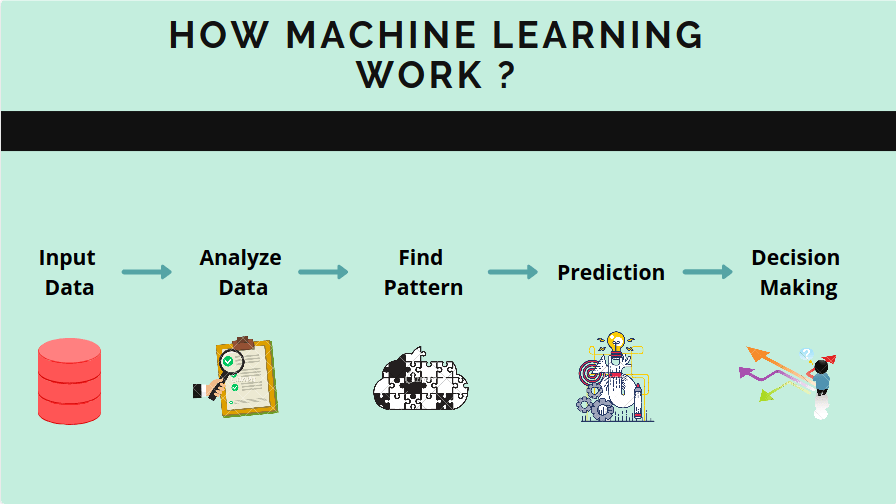
How does Machine Learning work?          

Machine Learning works with generation of predictions.    

  • Input Data
  • Analyse Data
  • Find Pattern
  • Predection
  • Decision making

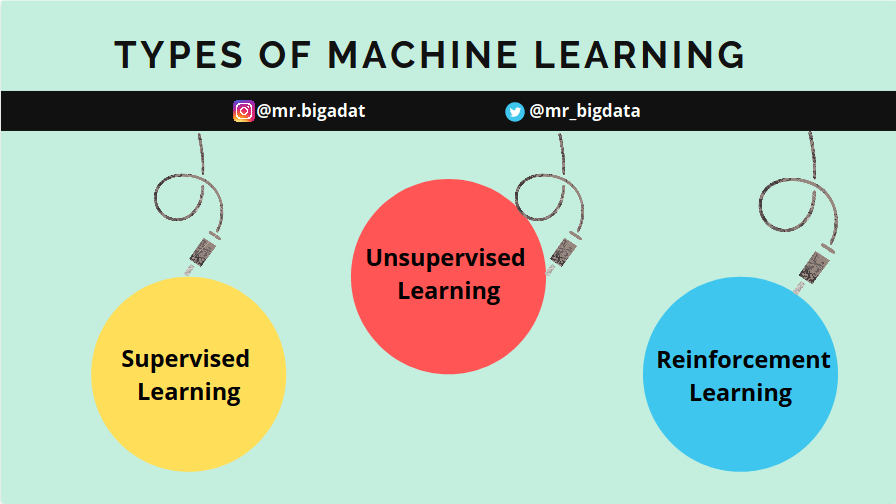
Types Of Machine Learning Algorithm     

In Supervised Learning, the dataset on which we train our model is labeled.there’s a transparent and distinct mapping of input and output. based on the instance inputs, the model is in a position to get trained within the instances. An example of supervised learning is spam filtering. based on the labeled data, the model is in a position to work out if the data is spam or ham. this is often a better form of training. Spam filtering is an example of this kind of machine learning algorithms. 

  • Unsupervised Learning                               

In Unsupervised Learning, there’s no labeled data. The algorithm identifies the patterns within the dataset and learns them. The algorithm groups the info into various clusters supported their density. Using it, one can perform visualization on high dimensional data.One example of this sort of Machine learning algorithm is that the Principle Component Analysis. Furthermore, K-Means Clustering is another sort of Unsupervised Learning where the info is clustered in groups of an identical order. The learning process in Unsupervised Learning is solely on the idea of finding patterns within the data.After learning the patterns, the model then makes conclusions.                                                                                                            

  • Reinforcement Learning                               

In programming robots to perform autonomous actions. it’s also used in making intelligent self-driving cars. allow us to consider the case of robotic navigation. Furthermore, the efficiency are often improved with further experimentation with the agent in its environment. This the most principle behind reinforcement learning. There are similar sequences of action during a reinforcement learning model.  

List of Common Machine Learning Algorithms :

  1. Linear Regression
  2. Logistic Regression
  3. Decision Tree
  4. SVM
  5. Naive Bayes
  6. kNN
  7. K-Means
  8. Random Forest
  9. Dimensionality Reduction Algorithms
  10. Gradient Boosting algorithms
    1. GBM
    2. XGBoost
    3. LightGBM
    4. CatBoost

In this machine learning tutorial, we went through the fundamentals of machine learning and how computing power has evolved over time to accommodate advanced machine learning algorithms. Computers are gaining intelligence due to the info that’s generated during a vast amount. We went through the various types of machine learning algorithms and further took a quick check out some of the popular ML algorithms. We hope that you simply are now well familiar with machine learning.   

Confused MUCH?  Don’t worry! Read this Mr.Bigdata latest Machine learning tutorial to get deep insight and understand why machine learning is trending.

Data Science – Python Introduction

mr.bigdata for data science

Python Language Introduction


Python is a widely used general-purpose, high level programming language. It was initially designed by Guido van Rossum in 1991 and developed by the Python Software Foundation.It was designed primarily to highlight the readability of the code, and allows its syntax for programmers to communicate concepts in fewer lines of codes.

Below are some facts about Python.

  • Python may be a widely used general-purpose, high-level programing language.
  • Python allows programming in Object-Oriented and Procedural paradigms.
  • Python programs generally smaller than other programming languages like Java and C++.
  • Programmers need to type relatively less and indentation requirement of the language, makes them readable all the time.
  • Python language is getting used by most tech-giant companies like – Google, Amazon, Facebook, Instagram, Dropbox, Uber… etc

The biggest strength of the Python is large library which may be used for the subsequent.

  1. Machine Learning
  2. GUI Applications (like Kivy, Tkinter, PyQt etc. )
  3. Web frameworks like Django (used by YouTube, Instagram, Dropbox)
  4. Image processing (like OpenCV, Pillow)
  5. Web scraping (like Scrapy, BeautifulSoup, Selenium)
  6. Test frameworks
  7. Multimedia
  8. Scientific computing
  9. Text processing and many more

Python is a programming language that permits you to work quickly and integrate systems more effectively.There are two major Python versions- Python 2 and Python 3. Both are quite different.

Beginning with Python programming:

  • Finding an Interpreter:


Before we start Python programming, we need to have an interpreter to interpret and run our programs. There are certain online interpreters like https://www.onlinegdb.com/online_python_interpreter, https://ideone.com/ or https://repl.it/languages/python3 that can be used to start Python without installing an interpreter.

Windows:There are many interpreters available freely to run Python scripts like IDLE ( Integrated Development Environment ) which is installed once you install the python software from http://python.org/
Linux:For Linux, Python comes bundled with the linux.

  • Writing first program:

Following is the first program in Python

#script begins
print("Hello Mr.Bigdata ") 
#output
Hello Mr.Bigdata

Let us analyze the script line by line.


Line 1 : [Script] starts in Python’s view #. So this statement is for readability of code and ignored by the Python interpreter.


Line 2 : [print (“Hello Mr. Bigdata”)] Python script is used to print on the console font function () but a line is printed (and including line drawing unlike C). The difference between Python 2 and Python 3 is the printed statement.. In Python 2, the “print” statement is not a function, and therefore can be invoked without parentheses. However, in Python 3, it is a function, and must be invoked with parentheses.

Python certainly is here for the long run. Are you?

Analytics Data Science Machine Learning Programming Python python class definition python class example python class method python data types python functional programming python function definition python function return python have data types python loop on list python loop on string python loops python range between

  1. Sourabh Yashwant Patil's avatar
    Sourabh Yashwant Patil on Python

    Good knowledge..